
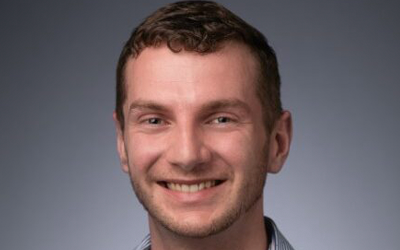
Dr. Nicholas See, Simon Fraser University
Funding: 2024 Michael Smith Health Research BC Research Trainee award, in partnership with Pacific Parkinson’s Research Institute and Parkinson Society British Columbia. $129,000 over 2 years.
Project description:
As a part of Prof. David Vocadlo’s research team, Dr. Nicholas See is highly interested in a Parkinson’s disease-linked protein called β-glucocerebrosidase or “GCase”. This protein belongs to a family of enzymes whose role in the human body is to catalyze, or “speed up,” important biological processes. GCase helps the brain break down certain fatty substances, called glycolipids. This is important for keeping brain cells healthy.
When the team first began work on this project, they realized that they needed a new avenue to accurately measure the activity of GCase in living human cells. As a result, they designed and synthesized a new chemical tool that fluoresces or “lights up” when processed by this enzyme. The intense signal given off by this molecule provides a powerful lens through which accurate observation of how quickly GCase operates in living human neuroblastoma (a type of cancer) cells is possible.
With this tool in hand, they have now planned a high-throughput screen – a powerful strategy which, when carefully executed, allows them to assess how individual molecules can affect the activity of a given protein. These studies would be laborious by hand, and are accelerated through automation. For this project, Dr. See and the team are going to use the state-of-the-art facilities at the Centre for High-Throughput Chemical Biology at Simon Fraser University to screen a high-quality library of ~4,500 molecules to see how they affect GCase activity. If a given molecule in the library causes an increase in fluorescence intensity over the observation period, they can infer that it is activating GCase either through direct binding or through a more complex interaction with a protein partner.
Dr. Nicholas See is a postdoctoral research fellow at Simon Fraser University, specializing in synthetic chemistry and chemical biology. After earning his PhD from the University of Queensland and completing a short appointment in New Zealand, he joined Prof. David Vocadlo’s lab, where he designs chemical tools to study neurodegenerative diseases like Parkinson’s. Dr. See combines lab-based synthesis with computational methods to better understand complex chemical reactions. Passionate about addressing health-related challenges through chemistry, he values interdisciplinary collaboration and is committed to science education.