
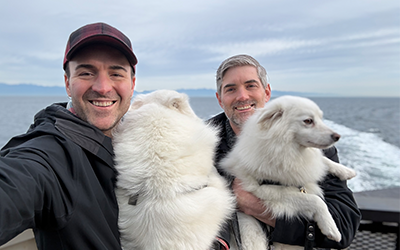
For people living with Parkinson’s disease (PD), support can come in many forms. For Dr. Jonathan Squires, a neurologist and movement disorder specialist, and his husband, Dam Dumsha, founder and president of an improv company, it comes from the clinic, the stage, and a shared commitment to giving people with PD the tools to live life in a new, empowering way.
Dr. Squires became interested in treating PD after seeing its effects on his grandmother, who lived with the disease. During his neurology residency, he was drawn to the field of movement disorders because of the variety of conditions he encountered. For Dr. Squires, one of the most meaningful parts of his work is getting to know people with Parkinson’s over time and finding ways to support their quality of life beyond short-term care.
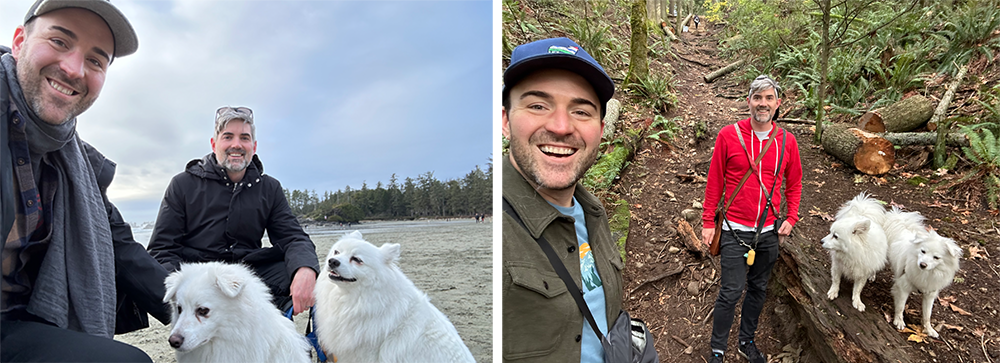
Dan first became involved with the Parkinson’s community in 2019, following Dr. Squires’ return from his movement disorders fellowship in New York City. At the time, Dan was teaching at the Improv Comedy Institute on Granville Island in Vancouver. One of Dr. Squires’ patients had shared a study from Northwestern University and Second City on improv as therapy for Parkinson’s. Dr. Squires suggested that Dan use that idea to propose a program of his own to the school. Initially, they had eight brave participants do a short series and showcase.
That early series became the foundation for what would eventually grow into Dan’s own organization, Improv for Work & Wellness (IFWW), which now runs programs focused on creativity, connection, and wellbeing, including for people living with Parkinson’s.
When Dr. Squires and Dan were in the early stages of talking about setting up improv for PD, they wanted to focus on improv skills that were deeply applicable to life with Parkinson’s – skills such as celebrating mistakes, a “yes, and…” attitude where performers have to accept anything their scene partner says or does and build off of it, and having to make the most of what your partner (or in real life, PD) throws at you.
Dr. Squires serves as IFWW’s medical advisor, guiding instructors on how to tailor exercises for people with Parkinson’s. Dan calls him their greatest resource, helping the team understand symptoms, shape best practices, and get the word out about the program.
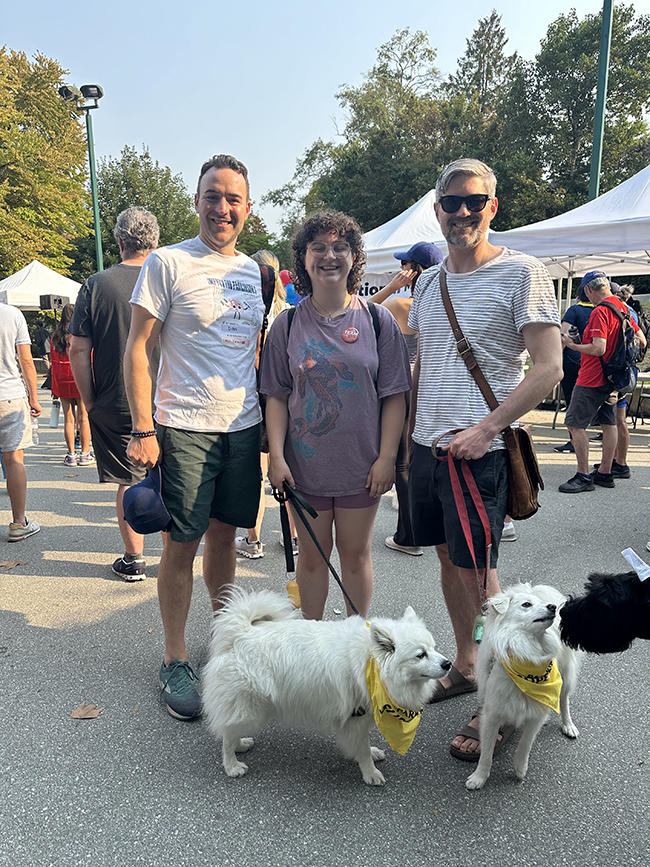
Throughout the years, they have both learned numerous things from working with people with PD that they did not expect. Dr. Squires says he never was taught how much grief shapes the experience of living with a progressive disease like Parkinson’s. He makes sure to name this for his patients now, in hopes it will help them cope. Dan says he is continuously struck by the creativity and resilience of those living with PD. He sees them find community through humour, adaptability, courage, and generosity – even on their most difficult days. Over time, their individual work has shaped each other’s perspective, blending Dr. Squires’ medical expertise with Dan’s creative approach to empower people with Parkinson’s.
Dan and Dr. Squires also encounter many misunderstandings about Parkinson’s, recognizing that the invisible symptoms are often overlooked. Dr. Squires notes how self-esteem can be impacted, and how mundane everyday tasks such as getting dressed can be exhausting. Dan highlights the major misconception that Parkinson’s looks the same for everyone, when in reality, it is a multifaceted, individual disorder. He says that, unfortunately, society can sometimes focus more on people’s limitations rather than abilities, but he is working very hard to change that narrative.
Though on the surface, their careers might look very different, Dr. Squires and Dan are ultimately focused on helping people cope and feel more at home within their bodies and lives. Dr. Squires says he tries to use the improv concept of celebrating mistakes with his patients, while encouraging them to live in the moment. He emphasizes a focus on one’s strengths, instead of dwelling on what PD has taken away from them. On the flip side, Dan has seen the impact and reassurance that compassionate medical care can provide, and how the simple act of being heard, believed, and taken seriously can ease fear when answers are not simple. At the heart of it, they both share a commitment to meeting people as they are, supporting their autonomy, and creating spaces where individuals with Parkinson’s can show up as their full, authentic selves.
Improv for Work & Wellness offers free online improv classes for people living with Parkinson’s or PD-like conditions. The Parkinson’s Performance troupe presents online showcases every other month, and are currently preparing for a June festival called the PILL (Parkinson’s Improv Laughter League). Full program details are available at: https://www.improvforworkandwellness.com/parkinsons